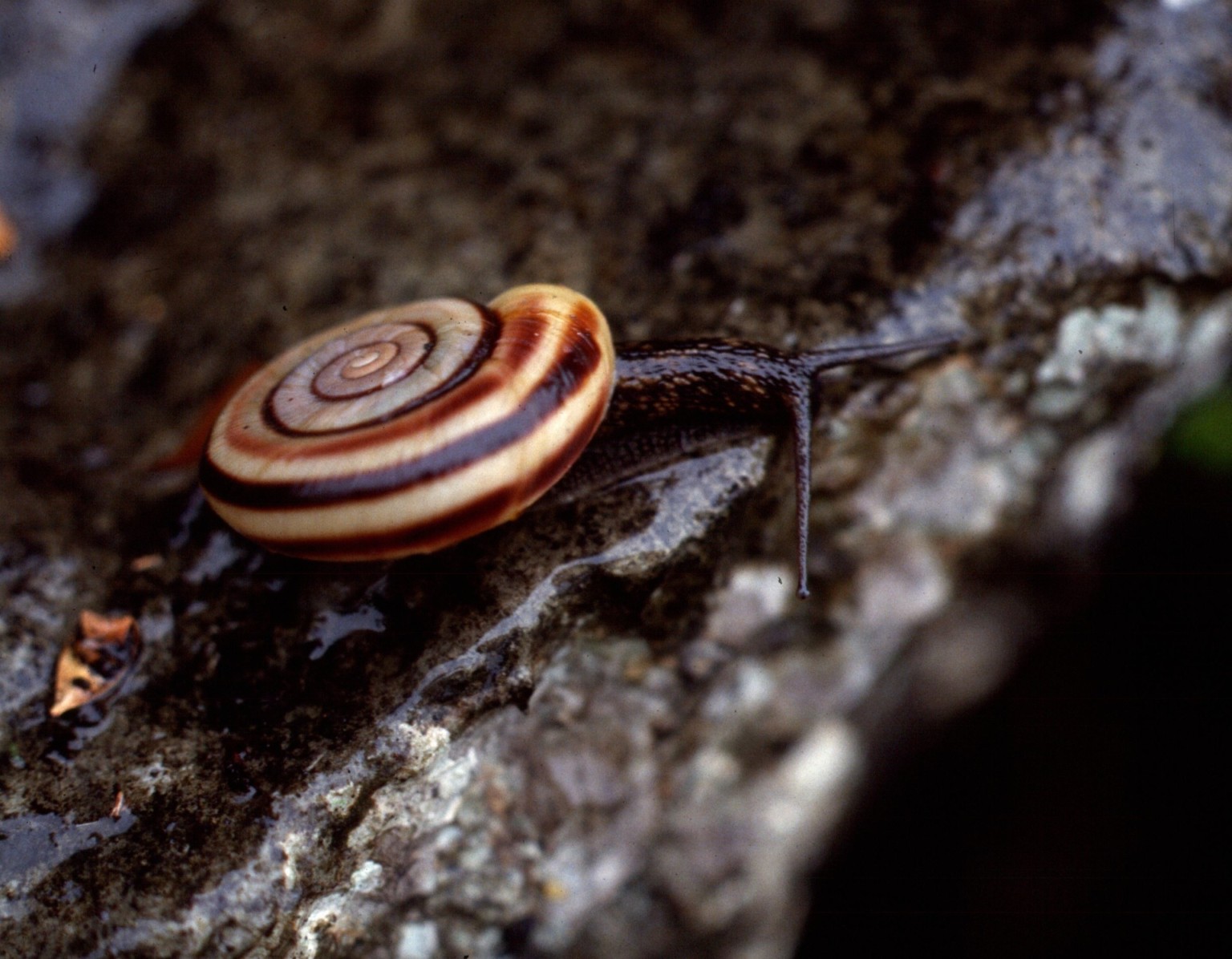
Unlocking the Diet of the Endangered Murayama-Maimai Snail!
A Major Step Forward for Future Conservation Efforts
A joint research team led by Assistant Professor Shun Itō of Shizuoka University’s Faculty of Science and Chairman Ichirō Yoshida of the Itoigawa UNESCO Global Geopark Natural Resource Conservation Committee has analyzed DNA found in the feces of the endangered "Murayama-Maimai Snail" (Euhadra murayamai), a species found exclusively on Mt. Myōjō in Itoigawa City, shedding light on key aspects of its diet.
These research findings were published on September 16, 2026, in the international academic journal Molluscan Research.
Research Overview
■ Who?
Shun Itō
Assistant Professor, Faculty of Science, Shizuoka University
Ichirō Yoshida
Chair, Itoigawa Geopark Natural Resource Conservation Committee
■ What?
Identified the plant species ingested/foraged by the rare species "Murayama-Maimai" through DNA extracted from its feces.
■ Where?
Mt. Myōjō in the Kotaki District of Itoigawa City, Niigata Prefecture
■ How?
To avoid harming this endangered snail, a non-invasive technique called "metabarcoding analysis" was used, detecting 11 native plant species across 11 genera, 11 families, and 8 orders (including Japanese pampas grass, boxwood, and Crimson glory vine) from genetic material in its feces.
Why is this discovery so important?
The Murayama-Maimai is a land snail species whose unique, flat, and beautiful shell shape led to severe overcollecting in the past, causing a dramatic population collapse that leaves it critically endangered today.
While designated and strictly protected under national law as a "National Rare Species of Wild Fauna and Flora" and locally as a "Specially Designated Rare Species of Wild Fauna and Flora" by Itoigawa City, basic ecological details—such as specifically what plants it feeds on in the wild—have long remained unknown.
This discovery is crucial because it allows us to establish evidence-based, efficient conservation strategies.
For example:
- Clear guidelines for habitat conservation (In-situ Conservation)
Scientific evidence now demonstrates the necessity of protecting the broader surrounding vegetation as a whole—spanning 8 to 11 plant families including boxwood and pampas grass—rather than focusing on single isolated plant species.
- Higher success rates for breeding & captive care (Ex-situ Conservation)
Utilizing data on the detected plant species is expected to contribute to more effective captive breeding and propagation, which has previously proven difficult.
The Murayama-Maimai: Pride of Itoigawa
Found nowhere else on Earth except Mt. Myōjō in Itoigawa City, the Murayama-Maimai is a truly unique local treasure exclusive to Itoigawa.
Having survived in the extreme environment of Mt. Myōjō's steep limestone cliffs, this snail serves as a powerful symbol of Itoigawa's rich natural heritage and biodiversity.
Conservation efforts have long been a trial-and-error process of "protecting the species without knowing how to increase its numbers." This research represents a massive leap forward toward preventing its extinction and eventually delisting it from rare species status.
We invite all citizens and visitors to take an interest in this irreplaceable story of life thriving in our local mountains and right beneath our feet.
A portion of this research was supported by the
Itoigawa Geopark Academic Research Grant Program.